

Deck: A data-driven look at how Ukraine stacks up against other global tech hubs — in skill, cost, and culture — and when businesses should choose it over alternative regions.
1. Executive Summary
As global demand for skilled software engineers continues to grow, companies face a strategic question: Where should we build development teams? The explosion of remote collaboration has made it easier than ever to hire globally — yet not all regions offer the same balance of cost, skill, and alignment.
Ukraine has emerged as one of the most attractive IT talent hubs for European and North American companies. With strong technical education, Western-aligned work culture, and competitive pricing, it remains a preferred destination despite ongoing geopolitical risks.
This article compares Ukrainian developers to other global talent markets — such as India, Poland, Latin America, and the U.S. — across three dimensions: skill, cost, and culture. We’ll examine the trade-offs of each model, when clients should choose Ukraine, and what the data says about the future of global IT outsourcing.
2. Understanding Global Sourcing Models
Before comparing regions, it’s important to understand how companies engage developers globally. There are three primary models:
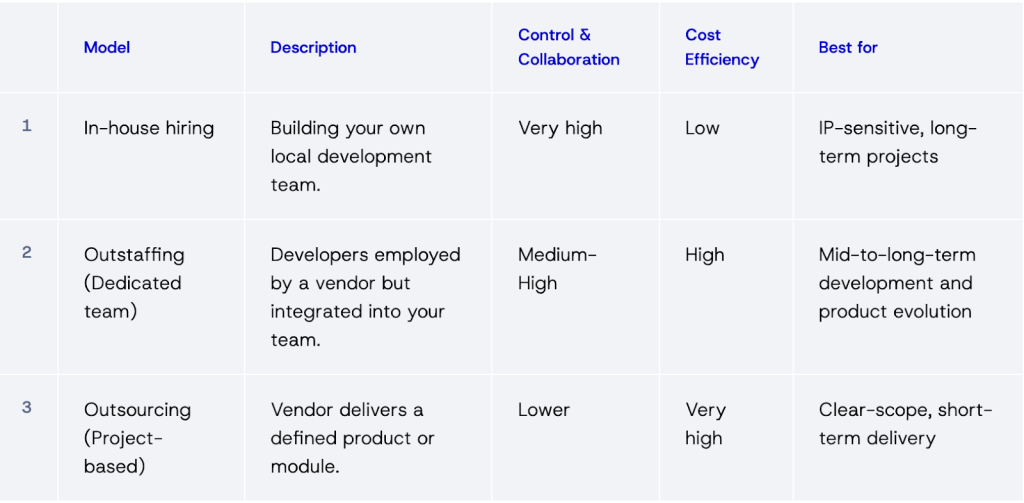
Each model can work — the key variable is where you source your team. That’s where Ukraine’s position becomes especially interesting.
3. Skill, Cost & Culture: Ukraine vs the World
3.1 Cost Comparison
Global cost differences remain one of the biggest drivers behind outsourcing.
According to RemotePass (2025), the average hourly rate for software developers is:
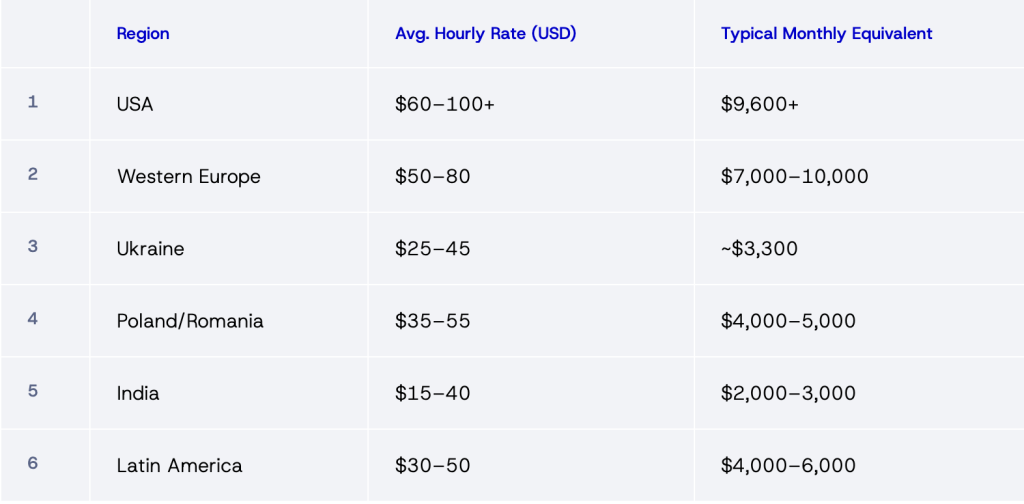
Ukraine offers a 40–60% cost advantage compared with Western Europe or the U.S., while maintaining higher skill and language proficiency than cheaper markets like India or the Philippines.
3.2 Skill and Education
Ukraine’s IT sector is powered by a deep STEM tradition. More than 200 universities offer IT-related degrees, producing over 20,000 engineering graduates annually.
According to Ardas-IT (2024) and Qubit Labs, Ukrainian developers often have:
- 4–8 years of experience on average
- Strong command of English (Intermediate–Upper Intermediate)
- Common expertise in JavaScript, Java, .NET, Python, and React
- Increasing specialization in AI/ML, DevOps, and Data Engineering
Global comparison:
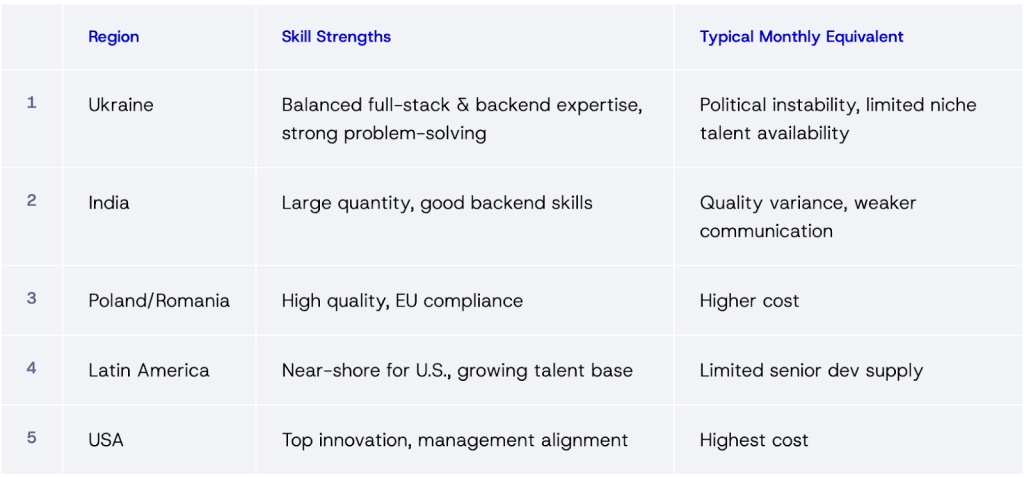
Ukraine sits between Western Europe (high quality, high cost) and Asia (low cost, inconsistent quality), giving it a sweet spot for value and performance.
3.3 Culture and Time-Zone Fit
Time-zone alignment matters for collaboration. Ukraine’s GMT+2/+3 zone overlaps perfectly with European clients and partially with North America.
Culturally, Ukrainian developers share Western business ethics — direct communication, proactive feedback, and ownership mentality — making collaboration smoother compared with more hierarchical or deferential cultures.
English proficiency: Over 80% of Ukrainian IT professionals report Intermediate or better levels
Cultural overlap: 8.5/10 alignment with EU norms (surveyed by CEE IT Association, 2024).
4. Pros & Cons of Choosing Ukrainian Developers
Pros
- Excellent cost-to-quality ratio
- Strong engineering culture and English proficiency
- Overlap with European business hours
- Mature vendor ecosystem with 3000+ software firms
- Proven crisis resilience (remote readiness since 2022)
Cons
- Rising salaries in high-demand niches
- Limited near-shore overlap for U.S. clients
- Competition for senior specialists in AI/ML and embedded systems
5. When to Choose Ukraine — A Practical Decision Matrix
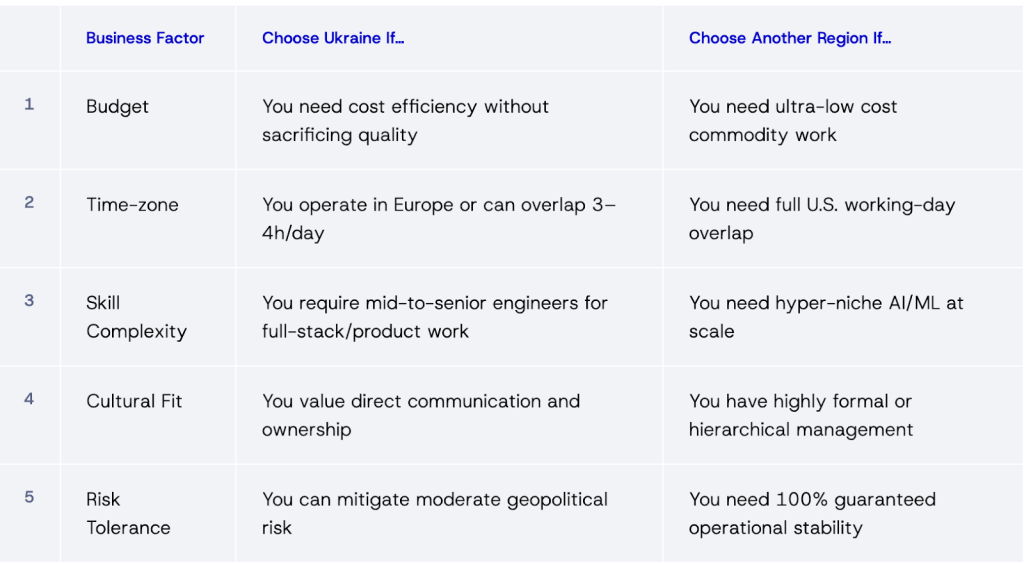
In most cases, European SMEs and well-funded startups find Ukraine the optimal balance of quality, alignment, and cost.
6. Implementation Best Practices
- Work with experienced vendors: Ensure they have distributed infrastructure and risk-management protocols.
- Run trial sprints: Start with a 2-month pilot before full engagement.
- Set transparent KPIs: Delivery speed, code quality, communication responsiveness.
- Maintain direct communication: Weekly syncs, shared task boards, feedback loops.
- Hybrid approach: Keep critical functions in-house, build delivery power in Ukraine.
7. Future Trends: What’s Next for Ukraine and Global IT
- Ukraine’s IT export volume grew to $7.3 billion in 2023 despite the war (IT Ukraine Association).
- The global IT outsourcing market is expected to reach $806 billion by 2029 (CAGR 9.6%) — Statista 2024.
- Demand for AI, cloud, and data engineering will outpace generic web dev, pushing regions with stronger senior talent (like Ukraine and Poland) ahead.
- Clients are shifting focus from cheapest vendor to strategic partner — valuing transparency, resilience, and shared culture over price alone.
8. Conclusion
The global talent landscape is more competitive — and more complex — than ever. While India, Latin America, and Western Europe each have their strengths, Ukraine’s combination of engineering excellence, cost efficiency, and cultural compatibility makes it a standout choice for many businesses.The decision shouldn’t hinge solely on hourly rates. It should reflect your company’s strategic priorities: collaboration depth, risk tolerance, and product complexity.
For many European and even U.S. clients, Ukraine remains not just an outsourcing option — but a strategic extension of their core engineering capability.